


Your investment personality: how it shapes your portfolio
Do you see yourself as cautious, adventurous, or perhaps somewhere in the middle? As we age, we tend to become more risk-averse, but when it comes to investments, this is not necessarily the case. Your attitude, and capacity to take risk, will depend on your circumstances and investment requirements. Here, we explore how your outlook shapes your portfolio.
A wealth manager will help you define your ‘investment personality’ at an early stage of your relationship with them. To some extent, this is about your inherent attitude to risk — and a 2019 study found that personal experience and environment have a far greater impact on this than genetic makeup. Other factors, such as your stage in life and your financial needs, also play an important part. A cautious investment strategy for a 40-year-old will look very different from one for a 65-year-old.
Your investment personality isn’t just a label — it’s integral to all aspects of your financial planning. Broadly speaking, cautious investors seek lower volatility, while balanced investors want growth with control. Adventurous investors embrace opportunity and will often have a longer time horizon in mind.
How do you define your investment personality?
Paul Willans, Managing Director of AJB Wealth, finds that there can often be a discrepancy between how potential clients see themselves and their investment choices to date.
‘Someone might say that they’re a cautious investor but be invested almost wholly in equities – more in line with an adventurous strategy,’ he says.
For this reason, psychometric testing is a useful tool during the process of getting know a new client.
‘It helps us to pinpoint people’s attitudes and values, including their risk tolerance and comfort with market fluctuations,’ says Willans. ‘This objective approach gives us a richer understanding of how we should manage their investments to achieve their goals.’
Three investment types
Financial advisers and wealth managers categorise investors across a spectrum of investment risk, depending on both their attitude to risk and other factors, such as time horizon and planned expenditure.
1. Cautious Investors
You prioritise capital preservation and steady, predictable returns. You may be retired or approaching retirement and prefer investments that minimise risk — even if that means lower growth. Your portfolio might lean heavily on bonds, cash equivalents and defensive equities.
2. Balanced Investors
You’re comfortable with moderate risk and seek a mix of growth and stability. You may be planning for retirement, helping children with education costs, or simply growing your wealth steadily. Your portfolio typically includes a blend of equities, fixed income and alternative assets.
3. Adventurous Investors
Not only are you willing to embrace higher risk for the potential of greater returns, but you have the capacity to do so. You may be younger, have a longer investment horizon, or have sufficient capital that you can place a portion of it in higher risk investments. Your portfolio could include emerging markets and smaller companies. Thematic investments may also have a role, i.e. investment strategies that focus on how long-term trends and themes are likely to drive growth.
These categories aren’t rigid labels but starting points, and something to reconsider over time.
Is cash the ultimate safe option?
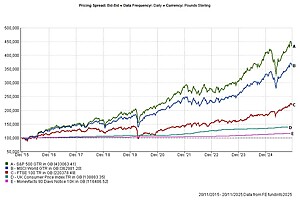
It can be easy to over or underestimate the risk attached to different types of investment. For example, more cautious individuals might choose to hold cash because it’s familiar and appears safe. However, this is to ignore the fact that cash also has risk attached to it, particularly during periods of inflation.
The graph below illustrates how £100,000 placed in a deposit account would have fared over the last ten years (line E), in comparison with inflation (line D) and three major stock market indices (lines A, B and C). Although equities can be volatile, they have provided real growth, over the longer term, whereas the value of cash in real terms has fallen.
The importance of a diversified portfolio
Having all your investments in one asset may be considered high risk. A diversified portfolio is essential in managing risk. It’s also important to recognise that there’s a large range of risk within each asset class. For example, fixed income markets (trading mainly bonds) can be higher risk than some equity markets (shares).
How does your investment profile impact on your portfolio?
Your investment profile should shape every aspect of your financial planning and asset allocation within your portfolio. A good wealth manager will always strive to achieve the best possible returns while minimising risk, but the level of acceptable risk depends on the client.
In turbulent times, the focus is on capital preservation for cautious clients. Meanwhile, those with adventurous portfolios are prepared to ride the ups and downs of the market, knowing that they can afford to wait for markets to bounce back. In all cases, there may be good buying opportunities during such times, but particularly for more adventurous investors.
‘To some extent, it’s about what you feel comfortable with,’ says Willans. ‘It’s important that you feel confident and are able to make informed decisions.’
How long should I invest for?
Clients often ask about investment timelines. The answer depends on your goals and stage in life and is linked to your capacity to take risk.
Short-Term (1–3 years): if you may need access to funds soon — for example, to buy a property or cover living expenses — then, a cash-based approach is likely to be appropriate for you.
Medium-Term (3–7 years): this is where you may require money in the next few years, but not necessarily. We can explore areas with potential for capital appreciation.
Long-Term (7+ years): when taking a long-term view, you have a higher tolerance for market volatility, and can afford to take a more adventurous approach, which has potential for greater investment growth.
In conclusion
Whether you’re just beginning your investment journey or refining a well-established portfolio, understanding your investor type is the foundation of smart financial planning – albeit just one aspect to consider when forming a strategy. A professional adviser can provide an objective framework for defining your investor type and using it to form a robust plan.
AJB Wealth is well placed to help with all aspects of financial planning and investment. To discuss your situation, please book an obligation-free meeting, or call us on 01428 774 070.
Important: The content of this bulletin is for general consideration only and does not constitute advice. No action must be taken, or refrained from being taken, without advice. This company accepts no responsibility for any loss occasioned as a result of any such action, or inaction. You are also reminded that investments can fall, as well as rise. And in the event of early encashment, you may receive less back than your original investment.


