


Cryptocurrency explained: risks, realities and common questions
Cryptocurrency is rarely out of the headlines. From periods of rapid growth to equally sharp declines, it’s an area that increasingly prompts questions from clients.
In this article, we aim to provide a clear and balanced overview of crypto-assets. Importantly, this article is not a recommendation to invest. It simply explains what crypto-assets are, why they attract attention and the role they may — or may not — play within a broader financial plan.
From outset, it’s important to recognise that these are high‑risk investments. Their value can fall significantly, and investors could lose some or all their capital. They will not be suitable for everyone.
What is cryptocurrency?
Cryptocurrency (often referred to as ‘crypto’) is a digital currency, outside the traditional banking system. No coins or notes change hands.
Transactions are recorded on a blockchain — a digital ledger that records ownership and transfers. Not every cryptocurrency uses the same type of blockchain, but the underlying principle is similar.
Bitcoin — sometimes called digital gold — was created in 2009 and is the best-known cryptocurrency, but there are thousands. CoinGecko, a leading data platform, tracks more than 16,000 different ‘coins’. Well-known cryptocurrencies include Ethereum, Litecoin and Stellar.
Though generally traded as an investment, and not accepted by most mainstream retailers, cryptocurrencies can be used for some purchases.
Who creates cryptocurrency?
Unlike traditional currency, cryptocurrencies are created not by governments, but by individuals, groups and companies.
Units of Bitcoin, and some other cryptocurrencies, are harvested through a process called mining. Miners compete to solve complicated mathematical problems and validate transactions. They are rewarded by coins when they succeed. In theory, anyone can mine coins, but it requires large amounts of energy and specialist equipment.
Many cryptocurrencies are not just a medium of exchange but have another function. They may be designed to power specific software programs, decentralized applications, or smart contract platforms.
Why are clients asking about crypto?
Interest in crypto has grown significantly in recent years, not least because of the strong returns over certain periods. Increased media coverage has helped fuel this interest. While some are keen not to ‘miss out’, others may be curious and keen to embrace new technology.
As with all investment matters, crypto should be considered objectively, and within the context of an individual’s overall financial objectives.
Cryptocurrency as an investment
Unlike traditional investments, crypto-assets do not represent ownership of a company and do not generate income such as dividends or interest. This means there is no widely accepted method for assessing their intrinsic value. Their value is largely driven by demand, scarcity and market sentiment.
Because crypto markets operate around the clock, prices can react immediately to geopolitical events and economic news, even when traditional financial markets are closed. During the Iran conflict, this has led to commodity traders and hedge funds using crypto-based markets to gain advantage.
Why has Bitcoin performed so strongly?
One reason Bitcoin has attracted attention is its finite supply. There will never be more than 21 million bitcoins, and fewer than a million are still to be mined. Supporters argue that it has characteristics similar to gold. Critics counter that scarcity alone does not determine value, and prices remain heavily influenced by investor sentiment.
Understanding the key risks
While the potential upside often attracts attention, it’s essential to understand that crypto-assets are high risk and highly volatile.
1. Market volatility
Crypto prices can move sharply and unpredictably. For example, the iShares Bitcoin exchange‑traded product shown in the chart below, has fallen some 40%, in Sterling terms, since launch in January 2025, illustrating how quickly values can decline.
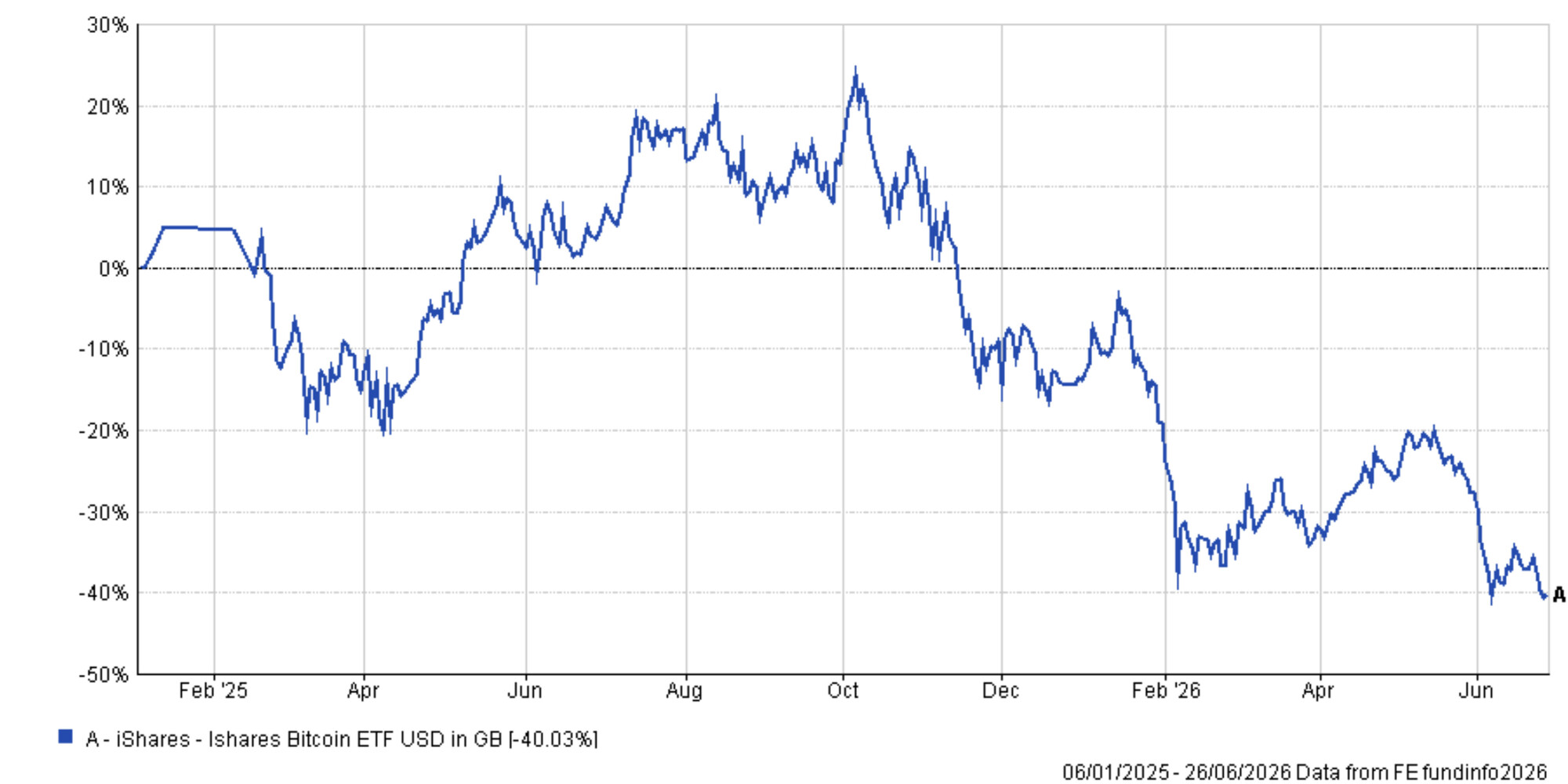
Past performance of this nature should not be relied upon when considering future outcomes.
2. Liquidity risk
In certain market conditions, it may be difficult to buy or sell crypto-assets. This can be particularly relevant during periods of market stress.
3. Custody and security risk
Crypto-assets rely on digital storage or third‑party providers. Safeguarding these assets can present practical and security challenges.
4. Regulatory and tax uncertainty
Regulation of crypto-assets is evolving across the globe, meaning it’s uncertain how rules will develop and be interpreted.
In the UK, the Property (Digital Assets etc) Act 2025 came into force in December, meaning that digital assets, such as cryptocurrency, can now be recognized as personal property. This provides greater protection and ensures they are treated like traditional assets.
While aspects of the crypto market are becoming more regulated (more on this below), the sector remains far less regulated than traditional investments.
5. Concentration risk
Holding a large proportion of wealth in any single asset class increases risk. In 2022, crypto lender, Celsius, filed for bankruptcy and owed its users $4.7 billion. Funds were frozen, with most customers receiving only partial refunds.
Unlike deposits with a UK bank, crypto holdings are generally not protected by the Financial Services Compensation Scheme (FSCS).
As with any investment, diversification and disciplined portfolio management remain essential considerations.
6. Behavioural risk
Crypto can be an emotive topic. Investment decisions may be influenced by sentiment, short‑term trends or differing attitudes to risk, which can create challenges for long‑term planning.
How do crypto-assets fit within a financial plan?
For most clients, the starting point is not the asset itself, but their broader objectives, risk tolerance and long-term plans.
Where crypto-assets are already held:
- A modest allocation may have a limited overall impact
- Larger holdings can introduce significant uncertainty
- As with any high‑risk or speculative asset, careful consideration needs to be given to how it interacts with the wider portfolio.
We do not advise on the selection or suitability of specific crypto-assets themselves, but we can help ensure that any holdings are considered within the context of an overall, structured financial plan.
Do you pay tax on crypto-assets?
In the UK, like many countries, Capital Gains Tax and Income Tax is payable on crypto-assets. CGT becomes payable when you sell, trade or spend crypto-assets.
What are stablecoins?
Stablecoins are a type of digital currency designed to bridge the gap between the volatility of cryptocurrencies and the stability of traditional currencies or assets. These digital currencies are pegged to stable assets, such as currency or commodities. For example, Tether is pegged to the US dollar. The Bank of England is currently working towards the regulation of sterling stablecoins, with rules expected to come into force from 2027.
Although designed to be more stable, stablecoins are not risk free and have occasionally lost their intended peg.
What about crypto exchange‑traded products?
In recent years, regulated exchange‑traded products (ETPs), often referred to as ‘crypto ETFs’, have become more widely available in some markets.
From 8 October 2025, changes to Financial Conduct Authority (FCA) rules allowed UK retail investors to access certain crypto exchange‑traded products listed on recognised exchanges.
These structures can provide a more familiar way of gaining exposure to crypto-assets through investment platforms. However, it is important to emphasise that:
- The underlying assets remain highly volatile
- These products do not remove or reduce the investment risk
- They are still considered high‑risk investments
Greater accessibility or regulation should not be interpreted as an indication that these investments are safer or more suitable. Regulation relates to how the product is structured and sold, not the volatility of the underlying crypto-assets.
The future of cryptocurrencies
As things stand, only certain crypto-assets, such as ETFs, are regulated by the UK’s FCA. However, a new regime to cover crypto-assets is in progress, and due to come into force in October 2027. In this way, cryptocurrencies are becoming more accepted in the mainstream investment landscape, though their long-term role remains uncertain.
In the future, it’s possible that the technology behind crypto may also be an efficient and cost-effective tool in financial services. What’s more, some believe that cryptos might one day be used in everyday transactions.
Our perspective
Crypto-assets are an evolving area, and it is entirely understandable that clients may have questions.
Our role is to:
- Provide clear, balanced and factual information
- Help you understand how different assets may affect your overall plan
- Ensure decisions remain aligned with long‑term objectives
We do not currently include crypto-assets within our core investment proposition. However, we are always happy to discuss the subject and help you consider how — if at all — it may fit within your wider financial planning.
AJB Wealth can bring clarity to all aspects of your financial planning. To discuss your situation, please book an exploratory meeting, or call us on 01428 774 070.
Important information: This article is provided for information and general awareness purposes only and does not constitute personal financial advice or a recommendation to invest in any particular asset or strategy. Nothing within it should be taken as a personal recommendation. Crypto-assets are high‑risk and complex investments, and not suitable for all investors. Their value can rise and fall rapidly, and investors could lose some or all their capital. Any decision to invest should be made with full understanding of the risks.


