


How to draw income efficiently in retirement
As retirement approaches, you begin to look at your investments from a new perspective. After decades of saving for the future, new questions come to the fore. How much can you afford to spend? And importantly, which sources of income should you use first?
The order and timing of withdrawals from pensions, ISAs and other investments can affect the tax you pay and the sustainability of your retirement income. However, a successful strategy is rarely as simple as choosing which pot to spend first.
‘The best way forward will depend on your circumstances and your hopes for the future,’ says Paul Willans, Managing Director of AJB Wealth. ‘Being aware of tax and investment considerations will help preserve your assets and give you flexibility in the years ahead.’
How much do you need?
How do you hope to spend your retirement? For some, this is a time for overseas travel, reconnecting with friends or pursuing hobbies. Others may simply yearn for a quiet life.
Drawing a distinction between your essential and discretionary expenditure is a useful starting point. While household bills should perhaps come from predictable income sources, Michelin-starred dinners might be funded more flexibly.
Map out your income sources
Many retirees have several sources of income, including both state and private pensions, ISAs, dividends and even part-time work.
‘Income can fluctuate,’ says Willans. ‘For example, someone retiring before State Pension age may rely more heavily on pensions and investments in the early years, then adjust those withdrawals when the State Pension begins.’
Cashflow planning will clearly illustrate when different income sources start and stop. It can also explore how spending might change over time and map out different scenarios.
Make use of available tax allowances
Many people delay pension withdrawals because pension income is taxable. In addition, pensions have traditionally offered a tax-efficient way to pass assets to the next generation. Unused pension savings are currently outside the scope of Inheritance Tax, but this is due to change in April 2027.
Even as things stand, leaving pension money untouched is not always the most effective approach. Making use of your tax-your free Personal Allowance or lower income-tax band can be preferable to delaying withdrawals and potentially paying higher tax rates later.
‘We don’t aim to minimise tax in a single year, but to manage it efficiently throughout retirement,’ says Willans.
Where appropriate, investments held in a General Investment Account (GIA) may be sold and the proceeds moved into an ISA. This is often called ‘Bed and ISA’. However, selling investments may crystallise gains or losses, so it’s important to check the tax and investment consequences.
Consider blending pension and ISA withdrawals
Should you spend your pension first, your ISAs, or your investment account (GIA) first? There isn’t a straightforward answer.
In many cases, combining withdrawals from pensions and ISAs can help meet spending needs while providing greater control over taxable income. The pension withdrawal may use available tax allowances, while the ISA can provide additional income without increasing taxable income. However, this also reduces the amount remaining within the tax-efficient ISA wrapper. Professional advice is advisable.
The impact of different withdrawal strategies
A coordinated strategy may involve withdrawing funds from several sources in the same year. The right approach will depend on many factors. These may include: your tax position, need for income security or access to cash, and your estate-planning objectives.
This is why a personalised plan can be a powerful tool. It can also be adjusted as spending, markets and legislation change.
Case study: comparing strategies
The simplified case study below shows how the order and combination of withdrawals might affect a retirement-income plan. While not a recommendation, it does illustrate the principle.
Richard is a 60-year-old retiree who needs a net income of £50,000 annually. He has a pension of £600,000, plus an investment account (GIA) and ISA worth £300,000 each. He has no earnings or other taxable income.
One option may be to draw an amount from the pension that makes use of available tax allowances, with the balance funded from ISA capital and, where appropriate, the GIA. There would be no tax to pay on withdrawals from his ISA. Sales from the GIA may be liable to Capital Gains Tax, depending on the underlying holdings, amounts and available tax exemptions.
The illustration below compares four simplified approaches for Richard’s pension income:
- GIA first
- ISA first
- Pension first
- Coordinated withdrawals
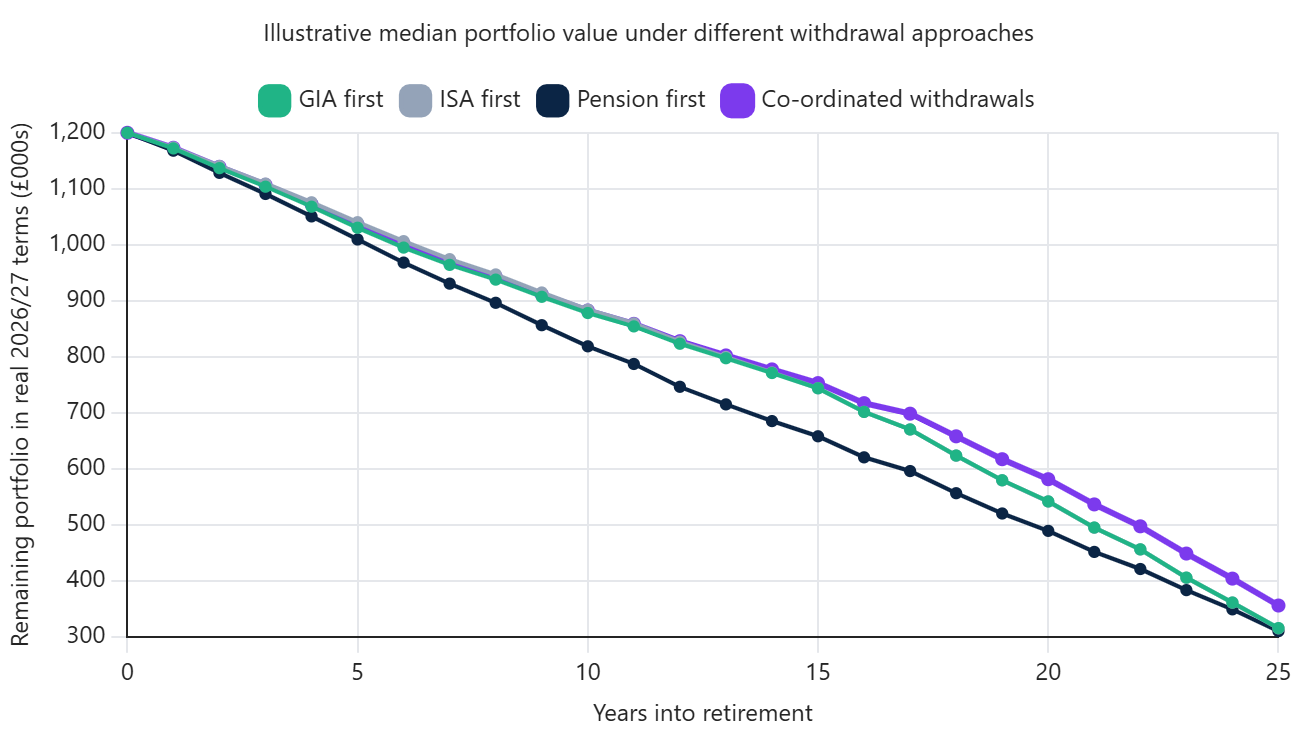
Caption: This simplified illustration compares several retirement withdrawal approaches. In later years, the ISA first line is no longer visible as it tracks the GIA first line. The coordinated strategy uses available tax allowances through phased pension withdrawals while drawing additional income from other assets as required. Outcomes will vary depending on individual circumstances, investment returns, tax rules and future income sources. Download more information on the assumptions behind the graph.
The graph shows how the coordinated approach changes the overall outcome compared with exhausting each account in turn. The most suitable strategy still depends on the retiree’s objectives, tax position and need for flexibility.
This example is not a recommendation. It ignores prior pension withdrawals and other personal circumstances. Allowances and tax bands may change, and different income-tax rates apply in Scotland.
Use pension drawdown carefully
At the time of writing, it’s generally possible to take a tax-free lump sum of 25% of a defined contribution pension, up to £268,275 for most people. Rather than taking all available tax-free cash at the outset, some people choose to phase it over several years.
Though not suitable for everyone, pension drawdown has become a popular alternative to buying an annuity as it allows a defined contribution pension to remain invested while amounts are withdrawn as required.
Where appropriate, drawdown allows the pension holder to:
- Wary withdrawals according to spending needs
- Manage taxable income from year to year
- Retain flexibility as circumstances change
- Keep part of the pension invested, accepting continuing investment risk
Unlike an annuity, flexi-access drawdown does not normally provide a guaranteed income for life. The fund may be depleted if withdrawals are too high, investment returns are poor or the individual lives longer than expected.
The amount of tax-free cash available will depend on the pension arrangement and benefits already taken.
Plan as a household, not as individuals
For married couples and civil partners, considering household assets together can sometimes create more planning options. Each person may be able to make use of their Personal Allowance, tax bands, ISA allowance and pension arrangements.
For example, a non-earner may still be able to receive tax relief on personal pension contributions of up to £3,600 gross each tax year.
Tax matters but it’s only part of the picture
A good retirement-income strategy must consider the wider picture:
Inflation erodes spending power
Retirement can last 20, 30 or even 40 years. Inflation can significantly erode spending power over time, so current income needs should not be considered in isolation.
How long you might live
Many people live longer than expected. A retirement-income strategy needs to support not just today’s lifestyle, but potentially several decades of future spending and for spending needs to change in later life.
The impact of market ups and downs
Poor investment returns early in retirement can have a particularly damaging effect when withdrawals require assets to be sold after falls in value. The portfolio may then have less capital available to benefit from a later recovery. This is called sequencing risk.
The right balance of risk
An overly cautious portfolio may struggle to maintain spending power, while excessive risk may expose the retiree to more volatility and loss than they can tolerate. A sustainable strategy should seek to balance tax efficiency, investment risk, liquidity, income security and the possibility of living longer than expected.
Avoid common pension withdrawal traps
Retirement-income planning is not just about opportunities. There are pitfalls too:
Emergency PAYE codes
The first flexible pension withdrawal is sometimes taxed using an emergency PAYE code, which can result in too much tax being deducted initially.
Restrictions on pension contributions
Taking taxable income flexibly from a defined contribution pension will normally trigger the Money Purchase Annual Allowance (MPAA). This can substantially restrict the amount that may subsequently be contributed to pensions with tax relief. However, taking a pension commencement lump sum only, and leaving the remaining fund invested will not normally trigger the MPAA.
Recycling tax-free pension cash into further pension contributions may also be caught by anti-avoidance rules.
Loss of valuable pension features
Moving into drawdown or transferring a pension may mean giving up guarantees, protected tax-free cash, valuable annuity rates or other scheme benefits. These features should be checked before any irreversible decision is made.
Your entitlement to means-tested benefits and care costs
Pension withdrawals may affect entitlement to means-tested benefits.
A note on pension scams
Be cautious about unsolicited approaches, pressure to act quickly and arrangements offering unusually high or guaranteed returns. Check the regulatory status of any firm, use trusted sources such as the FCA Register or ScamSmart, and consider regulated advice before transferring or accessing pension benefits.
Keep estate planning in mind
From 6 April 2027, most unused pension funds and pension death benefits will be included within the deceased member’s estate for Inheritance Tax purposes. Detailed guidance and supporting regulations should be checked when planning or reviewing beneficiary arrangements.
Estate planning should not be considered in isolation. Your own income, capital, care and later-life needs should remain the priority.
Review your strategy regularly
‘A retirement-income plan that works well at 60 may need adjustment at 70 or 80,’ concludes Willans. ‘Effective retirement planning is not static: it should be reviewed as spending, family circumstances, markets and tax rules change. That’s probably the most important lesson to take away.’
If you would like to discuss how your pensions, ISAs and other investments could work together in retirement, AJB Wealth would be pleased to help. Book an exploratory meeting here or call us on 01428 774 070.
Free and impartial pensions guidance is available from Pension Wise, a service from MoneyHelper. Pension Wise explains the options for taking money from a UK defined contribution pension but does not provide personalised financial advice.
Visit Pension Wise through MoneyHelper
Important: This article is provided for general information only and does not constitute personal financial, investment, legal or tax advice, or a recommendation to take or refrain from taking any particular action. Tax treatment depends on individual circumstances and may change. Information is based on our understanding of current UK tax rules and allowances at the time of writing, and different income-tax rates and bands may apply in Scotland.
The value of investments can fall as well as rise and you may get back less than you invest. Pension withdrawals, investment losses, inflation and charges can reduce the value and sustainability of future retirement income. Pension decisions may be irreversible, may affect means-tested benefits and may restrict future pension contributions.
Before taking benefits or making significant changes to pensions or investments, consider obtaining regulated financial advice. Free and impartial pension guidance is available from Pension Wise.


