


How should you use your ISA allowance in 2026?
As we near the end of the 2025–26 UK tax year, now is an excellent time to ensure that you’re making the most of your ISA and other tax-free allowances. This isn’t just about ensuring you don’t miss the 5 April deadline, but also about making the best investment choices for your situation and taking advantage of the flexibility built into the ISA rules.
Why have ISAs become more important?
In recent years, the government has increased taxes on investment gains through several measures, most recently by hiking tax on dividends and savings by 2% for most people. (See our article on the Autumn Budget.)
Meanwhile, tax relief on investment income and capital gains has dramatically reduced in the last 10 years. For example, in 2022 you could make a profit of £12,300 on selling shares before being liable for tax. That figure has now been cut to £3,000.
All this means that ISAs and other tax efficient tools have become more important to savers and investors. Thoughtful planning can make a significant difference. Even modest annual contributions will benefit from a snowball effect as the years roll on.
Individual Savings Allowance (ISA): the basics
As things stand, every UK resident aged 18 or over can put £20,000 into an ISA every year. Once held within an ISA, they’re free from income or Capital Gains Tax (CGT), no matter how large the pot. Sadly, unused allowances can’t be rolled over, so it pays to put plans into action ahead of 5 April.
This flexible system allows you to save or invest tax-free across these main types of ISA:
- Cash ISA – savings earn tax-free interest.
- Stocks and Shares ISA – income and capital gains from investments are tax-free.
- Innovative Finance ISA – peer-to-peer lending and other qualifying investments. These are considered higher risk, can be harder to sell, and only suit particular investors.
- Lifetime ISA – those aged 18 to 39 can save up to £4,000 per year toward long-term goals such as a first home or retirement, with the government contributing an extra 25%. See below for upcoming changes.
- Flexible ISAs – some providers offer flexible ISAs. This means it’s possible to withdraw funds and replace them, before the end of the tax year, without eating into your £20,000 allowance.
Cash ISAs vs Stocks and Shares ISAs: why it matters
We find many of our clients have built up substantial balances in Cash ISAs, over the years. While it’s important to have cash reserves, we recommend that the split between cash and other investments is kept under review. Savings rates are often low, and inflation eats into real returns, so cash will generally underperform in the long run.
Although your Cash ISA generates tax free interest, it does not have the potential to generate capital growth. In contrast, a Stocks and Shares ISA can hold investments with potential to grow in value, as well as generate income in the form of interest or dividends. This is particularly important for investors using their ISA to provide income. Sustained capital growth can help generate inflation-proofed income over the longer term.
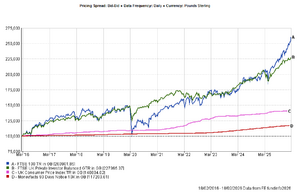
Indeed, the graph below shows the outcome over 10 years of putting £100,000 into a savings account (D) compared to inflation (C), a balanced portfolio (B) and the FTSE 100 equity index (A). While real assets do fluctuate in value, they provide real growth both in nominal and inflationary terms over the longer term, whereas the purchasing power of cash does not keep up with inflation.
If you regard your ISAs as longer term investments, then it makes sense to ensure that you’re using all the tax exemptions that they provide – i.e. protection from both income tax and CGT.
Can you transfer between different types of ISA?
Many investors do not realise that funds held in one type of ISA can be transferred into another type of ISA. This gives the flexibility to switch from cash to stocks and shares, or vice versa. The tax-free status of your ISA wrapper does not change, provided you follow the correct process.
Before considering such a change, it’s important to take account of your individual circumstances and risk profile. And this is where advice can be important.
Can you pay into more than one ISA in the same year?
In the 2025-26 tax year, and next year, you can split your £20,000 allowance across different types of ISA in any proportion. Since 2024, it’s even been possible to pay into more than one ISA of the same type, in the same year.
However, from April 2027, the overall allowance remains the same, but savers under 65 will only be able to pay a maximum of £12,000 into a Cash ISA.
What about Junior ISAs?
Junior ISAs are a popular way for family and friends to build up tax-efficient savings and investments for a child. The tax benefits are the same as an adult ISA – no Capital Gains Tax, and no further tax to pay on income. Withdrawals are possible from the age of 18 when it automatically converts to an adult ISA, meaning the pot can be useful to help with the cost of university or a deposit for a house. This tax year’s Junior ISA allowance is £9,000 per child.
What are the key benefits of ISAs?
1. A shelter from tax
When you sell shares or funds, you are liable to pay tax on gains over £3,000 per year. This is either 18% or 24% depending on whether you are a basic or higher rate taxpayer. Profits from shares and funds in an ISA are tax-free.
You also don’t pay tax on any dividends or other income you receive from investments held in ISAs. If outside an ISA, this income would be calculated as part of your annual income and taxed at 8.75% for basic rate and 33.75% for higher rate taxpayers. There is a tax-free dividend allowance of just £500.
Even small annual amounts paid into an ISA can mount up to a significant sum in the future.
2. Simpler tax returns
ISA income or gains should not be declared on a tax return, making life simpler.
3. Flexibility
ISAs offer a wide range of options for tax-efficient savings and investment, while allowing flexibility. Not only is it possible to switch between different types of ISA and provider, but funds can usually be accessed easily.
4. Spouses can inherit an ISA
A key point to note is that a spouse or civil partner can usually inherit the tax-free status of ISA savings and investments. When not inherited by a spouse or civil partner, the assets lose their tax-free status.
A breakdown of ISA changes on the horizon
While the ISA allowance itself remains at £20,000 for 2025–26 and beyond, significant changes are due in 2027 and 2028:
- From 6 April 2027, the amount you can put into a Cash ISA each year will be restricted to £12,000 for those under the age of 65. The remaining £8,000 of your £20,000 allowance will need to be used in investment-type ISAs.
- Those aged 65 and over will still be able to contribute up to £20,000 into a Cash ISA.
- New rules may also impact ‘cash-like’ assets, such as money market funds, in a Stocks and Shares ISA.
- Lifetime ISAs are set to be replaced by a new first-time buyer ISA in April 2028. Details will be confirmed following a consultation process, but it’s been announced that the new product will only provide a government bonus when the saver buys a property.
- At present, it’s still possible to open a Lifetime ISA and the government has said that those who have Lifetime ISAs can continue to contribute indefinitely. That’s true whether you’re saving for your first home or saving for retirement.
Plan ahead before 5 April 2026
The tax year deadline — midnight on 5 April 2026 — is approaching fast. To make the most of your ISA allowances this year:
- Check your unused allowance: make sure you’ve fully used your £20,000 where possible.
- Review your cash holdings: ask whether excess cash might be better positioned in a Stocks and Shares ISA to target growth or inflation-proofed income.
- Transfer instead of withdrawing: if you want to move cash from a Cash ISA to a Stocks and Shares ISA, you should do this via a formal transfer process, through your new provider, rather than withdrawing funds yourself. This preserves your ISA wrapper’s tax benefits.
Don’t forget other allowances
Your ISA isn’t the only tax-efficient wrapper available:
Pension Contributions: Contributions to pensions such as Personal Pensions or SIPPs receive tax relief at your marginal rate, and there’s an annual allowance of up to £60,000 (subject to your circumstances). Using pension allowances can be especially valuable for long-term retirement planning.
Gifting Allowances: Inheritance Tax annual gift allowances can be used to pass wealth efficiently to family members. It’s worth considering these as part of a broader financial plan.
Final thoughts
An ISA is a powerful tax-efficient vehicle, but how you allocate your allowance — between cash, investment, pensions, and other strategies — can have a meaningful impact on your future goals.
With the 2025–26 ISA year closing soon and ISA reforms on the way, now is an ideal time for to review your investment choices. A professional adviser can help you hone the best strategy.
‘While only £20,000 a year, successive investment into ISAs over the long term can have a profound effect on people’s accumulated savings,’ says Paul Willans, Managing Director of AJB Wealth. ‘Indeed, we have clients whose entire investment portfolio is now wholly within ISAs and their returns are tax-free for life. This doesn’t happen by chance but comes about through considered planning.’
AJB Wealth brings clarity and confidence to your financial planning. To discuss your situation, please book a no-obligation meeting, or call us on 01428 774 070.
Important: The content of this bulletin is for general consideration only and does not constitute advice. No action must be taken, or refrained from being taken, without advice. This company accepts no responsibility for any loss occasioned as a result of any such action, or inaction. You are also reminded that investments can fall, as well as rise. And in the event of early encashment, you may receive less back than your original investment.


