


What should you do with a financial windfall?
Many of our clients are experienced investors; others come to us having received a financial windfall and seek advice on how to invest a lump sum. Whether it’s come through an inheritance, the sale of a business or some unexpected event, this is an opportunity to shape one’s future.
While a sudden influx of cash can open doors and bring greater security, it can also be a source of angst and may come in tandem with other major changes. At AJB Wealth, we often work with clients at such a turning point. Careful planning will help make the most of newfound prosperity and enrich life in general.
‘Allow yourself time to adjust before making big decisions,’ advises Paul Willans, Managing Director of AJB Wealth. ‘People’s first instinct can be to put everything into a savings account, especially when new to investing. But while cash may be a good initial home, the value is likely to be eroded over time, due to inflation and lack of any potential for capital appreciation.’
If you had put £100,000 in a 90-day notice savings account 25 years ago, it would now be worth £164,931. This is £22,603 less than the rise in inflation, so the value of your money would have fallen in real terms. In comparison, £100,000 in the FTSE All Share Index would now be worth £356,696. (More on this below.)
This 10-point article focuses on the financial planning and investment considerations around managing a sudden lump sum, along with the impact on you as person.
1. What are your immediate financial obligations?
Are there any debts or liabilities you should pay off? Consider the rate of interest you pay on any loans, plus early repayment charges. If you have a fixed rate mortgage, for example, it may make sense to wait until the end of the fixed rate term.
Likewise, if you have ongoing financial commitments, such as tuition fees for children or home renovation costs, consider how the lump sum could help with these costs.
2. Create an emergency fund
An emergency fund should be part of your plan if you don’t already have one. A health issue, family emergency or unforeseen repairs can happen at any time of life. Ideally, your emergency fund should cover at least three to six months of living expenses.
A simple savings account may be the best option. The returns are low, but emergency funds are available at short notice.
3. What do you want your future to look like?
Focus on your long-term goals. For many, retirement will be a key focus. Others may wish to fulfil the dream of starting a business, work on a charitable endeavour, or support their family in some way.
‘Whatever your aspirations, this is the time to consider what you want from life over the next decade or two, and beyond,’ says Willans. ‘A large sum of money can certainly be life changing.’
Even if retirement seems a long way ahead, think about what you’d want your post-work life to look like. What age would you like to retire? How much income would you need to live comfortably?
4. Set financial goals for the next 10 to 20 years
A wealth manager can help you form a strategy in line with your goals. The amount you need for retirement is likely to be a key focus. At AJB Wealth, we use sophisticated cashflow analysis to help people understand how their situation may develop over time, and plan for the future in a meaningful way.
5. Get the right professional advice
Even if you feel confident about your financial knowledge, it may be sensible to consult a professional to ensure that all angles are covered.
For some, a financial adviser or IFA will be suitable. Others may wish to benefit from the more comprehensive service offered by a Chartered Wealth Manager. See our earlier articles on the differences between a financial adviser and wealth manager. A company like AJB Wealth can manage your investments on a discretionary basis. This means your investment portfolio is actively managed on a day-to-day basis, without you needing to be involved when routine investment decisions are made.
Depending on your situation, you may also benefit from input from an accountant or solicitor.
6. Pinpoint tax-saving and investment strategies
Tax-efficient investments: Make the most of tax-efficient options such as ISAs. It’s possible to contribute up to £20,000 per year in a Cash ISA or Stocks and Shares ISA.
Niche investments, such as Venture Capital Trusts (VCTs) and Enterprise Investment Schemes (EIS), may also be appropriate. This is particularly true where there may be a Capital Gains Tax (CGT) liability on your lump sum, for example if you sold your business. These would allow you to roll over the CGT. However, these investments tend to be riskier, so it’s essential to consider their overall suitability for your circumstances and risk profile, and to take professional advice.
Optimise pension contributions to take advantage of tax relief where appropriate. Bear in mind that even if not working, you can make contributions of up to £2,880 per year (which are then topped up to £3,600 by the government). And that you can benefit from tax relief on contributions up to the age of 75.
Diversify your investments to include equities, bonds, and other asset classes. The way you invest will depend on your attitude to risk and your overall circumstances.
7. Investment strategy: balancing risk and reward
Investing a lump sum requires careful thought. A financial planner or wealth manager will assess your risk tolerance before helping you to form a strategy that will help you achieve your life goals. It’s important to balance growth with risk management.
Equities, while volatile in the short term, can offer higher long-term returns. Bonds, on the other hand, tend to offer more stability and regular income. The balance will depend on how comfortable you feel with market fluctuations and how far away you are from retirement.
The graph below shows the rise in value over 25 years of £100,000 in the FTSE All Share Index compared to the same amount put in a 90-day-notice savings account. It also shows how inflation has risen over the same period.
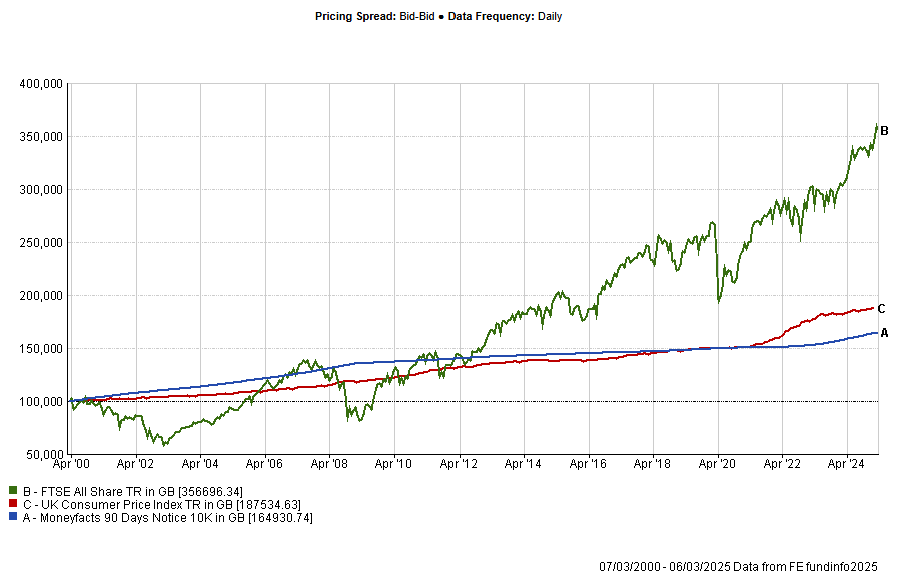
However, while the above graph illustrates how equities have historically outperformed, they can be volatile in the short term. Therefore, it’s important for any portfolio to be diversified across, and within, asset classes. That way, it’s possible to reduce portfolio volatility to match your personal capacity to take risk.
8. Review estate planning and Inheritance Tax (IHT)
A lump sum can have significant implications for your estate and inheritance planning. The current IHT threshold is £325,000, with a 40% tax rate charged on estates above this amount (subject to reliefs and exemptions). This means that if your combined assets — property, savings, pensions, and other investments — are likely to exceed this amount. With careful planning, you might be able to mitigate IHT.
You may consider:
· Using gifting strategies to reduce the value of your estate.
· Establishing trusts for family members.
· Reviewing your will to ensure it still reflects your intentions.
· Maximising the potential for the use of the Nil Rate Band and Residence Nil Rate Band.
Your solicitor and wealth manager may work together to help you achieve the best outcome.
9. Consider the impact on you as a person
Having to manage a sizeable financial windfall is a great problem to have to deal with! Nevertheless, it can trigger a range of emotional responses.
For many, it’s an overwhelming feeling of relief, while for others, it can feel anxiety-inducing, as they consider the responsibility of managing the sum properly. There can also be concerns about family expectations, the fear of making the ‘wrong’ decision, or the potential for wealth to change relationships. Taking the time to address these emotional factors is key to maintaining a healthy perspective.
Talking to a trusted wealth manager or financial planner, who can offer impartial advice and break down your options, may help alleviate any concerns. In some cases, it might even be worth seeking support from a life coach or other professional.
10. Windfalls over £1 million
The larger the windfall received, the more consideration needs to be given to factors such as tax and estate planning. Trusts are more likely to come into play. For many individuals, philanthropy might become an important part of their goals.
On a personal level, greater care may be needed in managing relationships with friends and family, as changed financial circumstances can alter dynamics. Some lifestyle changes may need great consideration. For example, you may no longer need to work, but might you miss it more than you’d expect? And if you have children, how will the changes impact them?
Some say that one key to deriving greater fulfilment from your wealth is to focus on experiences rather than the accumulation of material goods. Other positive behaviour includes building healthier lifestyle habits and using money in a way that benefits others.
Conclusion
A financial windfall can bring financial security for the future, and all-round greater life satisfaction. For most people, it would be prudent to seek professional advice at the outset.
A wealth manager can:
· Help you form a strategy.
· Ensure that your affairs are tax efficient.
· Proactively manage your investments.
· Strike the right balance between risk and reward.
AJB Wealth is well placed to help with all aspects of financial planning and investment. To discuss your situation, please book an obligation-free meeting, or call us on 01428 774 070.
Important: The content of this bulletin is for general consideration only and does not constitute advice. No action must be taken, or refrained from being taken, without advice. This company accepts no responsibility for any loss occasioned as a result of any such action, or inaction. You are also reminded that investments can fall, as well as rise. And in the event of early encashment, you may receive less back than your original investment.


